
Why Businesses That Move Beyond Social Media Scale Faster and More Predictably
For many small and medium businesses, social media becomes the starting point for sales.
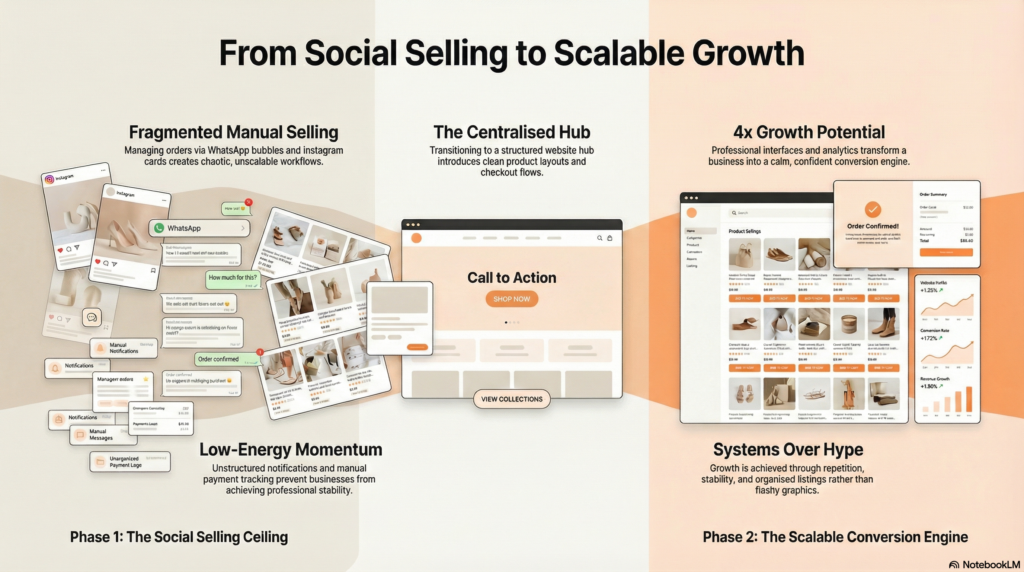
Instagram, WhatsApp, and marketplaces help build early traction. Orders come through DMs. Payments happen manually. Growth feels exciting at first.
But after a point, sales slow down.
Not because demand disappears, but because the system cannot scale.
This is where websites change the game.
In 2026, a website is no longer just an online brochure. It is a conversion engine that helps businesses sell consistently, build trust, and grow beyond platform limitations.
At Grainzap, this pattern shows up repeatedly. Businesses that move from social-only selling to a structured website often unlock multiple growth levers at the same time. When combined, these levers can increase sales significantly over time.
This blog explains how websites enable sales growth, why the impact compounds, and how real businesses scaled after launching their websites.
First, what “4x sales” actually means in practice
A website does not magically multiply revenue overnight.
Sales increase because a website improves four critical areas simultaneously:
• Conversion rate
• Trust and credibility
• Traffic sources
• Repeat purchases
Each improvement alone may look small. Together, they compound.
For example
Better conversion doubles results
More traffic doubles opportunities
Repeat customers increase lifetime value
This is how sales multiply sustainably.
1. Websites convert better than social media alone
Social media is designed for engagement, not conversion.
People scroll quickly. Conversations happen in fragments. Buying decisions require back and forth.
A website removes friction.
A well-built website
Explains the product clearly
Shows pricing transparently
Answers common objections
Guides users toward a clear action
Instead of replying to the same questions repeatedly, the website does the selling at scale.
Even a modest improvement in conversion rate can significantly increase revenue when traffic remains the same.
2. Websites build trust that social platforms cannot
Trust is the biggest conversion factor for small and medium businesses.
A website creates legitimacy.
Customers trust businesses more when they see
A professional storefront
Clear product details
Policies and contact information
Customer reviews and FAQs
In 2026, buyers are cautious. A website reassures them that the business is real, accountable, and reliable.
Higher trust leads directly to higher conversion and fewer abandoned purchases.
3. Websites unlock multiple traffic channels
Social media traffic is limited to algorithms.
A website opens the door to new demand.
Websites allow businesses to
Rank on search engines
Appear in AI search results
Run conversion-focused ads
Capture organic intent
This means sales no longer depend on one platform.
When traffic comes from multiple sources, sales become more stable and scalable.
4. Websites enable repeat purchases and customer retention
Social selling focuses on one-time transactions.
Websites enable relationships.
Through a website, businesses can
Collect customer data
Send follow-up emails
Offer repeat discounts
Launch new products easily
Repeat customers are cheaper to convert and spend more over time.
This is where long-term revenue growth accelerates.
Case Study 1: Beardbrand
From content-led brand to multi-million-dollar ecommerce business
Beardbrand started as a niche grooming brand focused on beard care. In its early days, growth came from community and content rather than aggressive advertising.
The turning point came when Beardbrand invested heavily in its website and ecommerce experience.
What changed after the website became central to the business:
• Conversion focused product pages replaced manual selling
• Content drove traffic directly to owned pages
• Email and repeat purchases increased significantly
According to publicly shared interviews, Beardbrand crossed eight-figure annual revenue within a few years of building a strong direct-to-consumer website. A large portion of that growth came from owning customer relationships instead of relying only on platforms.
The website allowed Beardbrand to scale sales without scaling manual effort.
Case Study 2: Gymshark
How a small fitness apparel brand scaled globally through its website
Gymshark began as a small UK-based fitness apparel business selling through social media and influencer partnerships.
The real acceleration happened when Gymshark focused on its ecommerce website.
Key changes enabled by the website:
• Direct-to-consumer sales replaced third-party dependence
• Influencer traffic converted through optimized landing pages
• Email and product launches drove repeat revenue
Gymshark publicly reported revenues growing from under £10 million to over £100 million annually within a few years. The website was the backbone of this scale, allowing global reach without proportional operational complexity.
Social media brought attention. The website converted it.
Why websites outperform social-only selling over time
Social media is rented attention.
A website is owned infrastructure.
When platforms change algorithms, businesses without websites lose visibility. Businesses with websites retain control.
In 2026, stability matters as much as growth.
Websites provide
Predictable conversion paths
Data ownership
Scalable systems
Long-term brand equity
This is why businesses that invest early scale more smoothly.
Common reasons small businesses delay building a website
Many businesses hesitate because
They are not technical
They fear high costs
They do not trust freelancers
They feel social media is “working enough”
In reality, the cost of delay is often higher than the cost of building.
Every month without a website limits growth potential.
What makes a website actually increase sales
Not all websites drive growth.
Sales-focused websites prioritize
Clear messaging
Simple navigation
Fast loading speed
Mobile usability
Strong product presentation
A website built for conversion behaves very differently from a website built only for design.
How Grainzap helps businesses turn websites into sales engines
Many businesses come to Grainzap after hitting a growth ceiling.
They have traffic.
They have demand.
They lack structure.
We help by
Designing conversion-focused websites
Choosing the right platform for non-technical teams
Aligning website messaging with social and ads
Building systems that support repeat sales
Our focus is not just launching websites. It is building revenue infrastructure.
When the website works, marketing becomes easier and sales become predictable.
Final summary
• Websites improve conversion by reducing friction and confusion
• Trust increases when businesses look professional and transparent
• Multiple traffic sources unlock consistent demand
• Repeat purchases grow lifetime value
• Sales multiply through compounding improvements, not shortcuts
• Real businesses scaled by owning their website and customer journey
• Grainzap helps small and medium businesses build websites that actually sell