
Pinterest is one of the few platforms where growth in 2026 is still unevenly distributed.
Some accounts post for years and see nothing.
Others publish a few pins every week and quietly generate thousands of website visits every month.
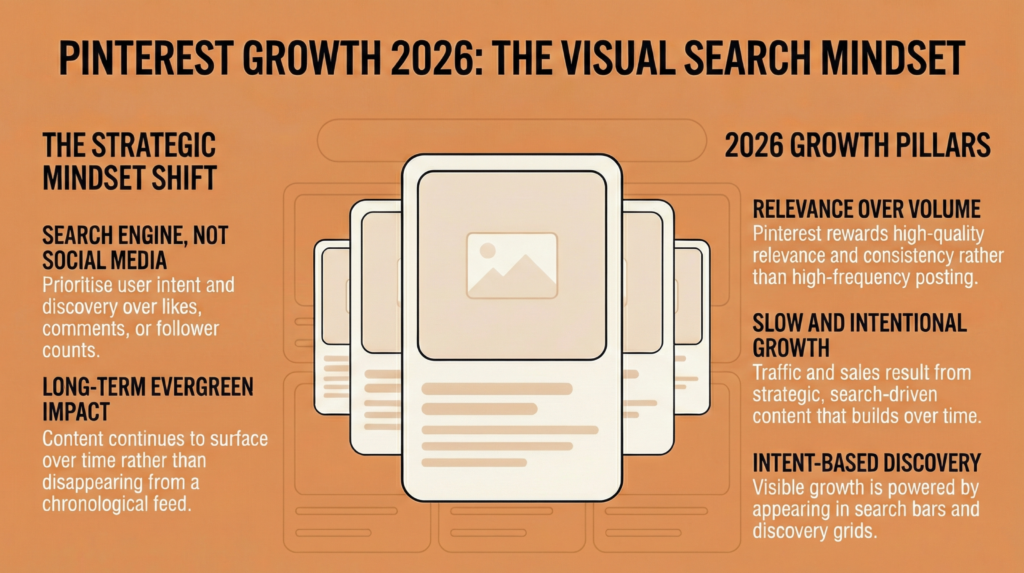
This gap exists because Pinterest is not a social network in the way most people understand social media. It is closer to a visual search engine with long memory.
If Pinterest feels slow or confusing, it is usually not because the platform is dead. It is because it is being used incorrectly.
This blog explains how Pinterest growth actually works in 2026, using real examples, realistic metrics, and clear cause and effect.
Why Pinterest Is Still Misunderstood
Most creators and businesses approach Pinterest like Instagram.
They focus on followers.
They focus on aesthetics.
They post inconsistently and expect immediate engagement.
Pinterest does not reward any of that.
Pinterest users arrive with intent. They are planning a purchase, a project, a decision, or a future action. They are not there to follow creators casually.
That is why Pinterest content behaves differently.
A pin created today can still generate traffic twelve months later. An Instagram post rarely survives beyond a day.
This difference alone changes how growth must be approached.
How Pinterest Has Evolved by 2026
Pinterest has leaned harder into intent driven discovery.
By 2025, Pinterest reported that over 85 percent of weekly users use the platform to plan purchases or projects, not to pass time. In 2026, this behavior is even more pronounced due to AI powered recommendation and search refinement.
As Bill Ready has stated publicly, Pinterest is designed for people who want to do something next, not just consume content.
This is why Pinterest prioritizes usefulness, clarity, and relevance over popularity.
How Pinterest Actually Works in Practice
Pinterest works like this:
Someone searches for an idea.
Pinterest scans its database of pins.
Pins are ranked based on relevance, engagement history, and clarity.
Follower count is a weak signal. Keyword relevance and save behavior are strong signals.
For example, an account with 200 followers can outrank an account with 20,000 followers if its pin matches search intent better.
This is why Pinterest remains one of the few platforms where small accounts can still win.
Why Most Accounts Fail to Grow on Pinterest
Most Pinterest failures come from randomness.
Common patterns include
Creating pins without keyword intent
Using vague titles like “Business Tips”
Designing pins that look nice but say nothing
Pinning for a few weeks and stopping
Pinterest does not reward experimentation without structure. It rewards repeatable usefulness.
When Pinterest cannot understand what an account is about, it stops distributing content.
What Growth on Pinterest Actually Means in 2026
Growth on Pinterest is not measured by followers.
Real growth looks like this:
An account publishes 30 to 40 well targeted pins.
After three months, impressions start increasing steadily.
After six months, a few pins begin driving consistent outbound clicks.
After one year, older pins outperform newer ones.
For many niches, one strong pin can generate 200 to 500 monthly visits for months without additional effort.
Pinterest growth is cumulative. Every pin is a long term asset.
Keyword Research Is the Real Growth Lever
Pinterest growth begins with keywords, not design.
The Pinterest search bar itself is the best research tool. When someone types “small business marketing”, Pinterest suggests phrases like
small business marketing ideas
small business marketing plan
small business marketing strategy
These suggestions reflect real search demand.
Successful accounts build content around these phrases naturally, not forcefully.
For example:
Weak pin title
“Marketing Tips for Entrepreneurs”
Strong pin title
“Small Business Marketing Plan for 2026”
The second pin aligns with explicit intent. Pinterest understands it. Users click it.
Content That Actually Performs on Pinterest
Pinterest favors content that helps users move forward.
High performing formats include
How to guides
Step by step processes
Planning frameworks
Before and after transformations
Example:
A pin titled
“How a Small Restaurant Increased Orders Using QR Menus”
Will outperform
“Restaurant Growth Ideas”
Because the first promises a specific outcome.
Pinterest rewards specificity.
Design That Drives Clicks, Not Compliments
Design matters, but clarity matters more.
Successful pins usually share these traits
Vertical format
Large readable text
One clear idea per pin
Minimal distraction
For example, a simple pin that says
“Pinterest Strategy for Small Businesses in 2026”
Often outperforms a complex design with no clear message.
Pinterest is consumed quickly. Users decide in seconds whether to save or click.
Posting Frequency and Realistic Expectations
Pinterest favors consistency, not bursts.
Accounts that grow steadily usually pin between 3 and 10 times per day, often by repurposing one blog into multiple pins.
For example, one blog post can generate
3 headline focused pins
2 checklist pins
2 step based pins
This is how accounts scale without creating endless new content.
Quality still matters. Reposting random designs does not work.
Boards Strategy That Actually Helps Distribution
Boards help Pinterest categorize content.
Successful accounts use niche specific boards like
Pinterest Marketing Strategy
Small Business Growth Ideas
Content Marketing Planning
Not broad boards like
Business Inspiration
Each board reinforces topical authority. Pins saved to relevant boards perform better over time.
Boards are context signals, not decoration.
Pinterest for Businesses vs Creators
Businesses use Pinterest to drive traffic and sales. Their success metric is outbound clicks.
Creators use Pinterest to build authority and long term audience discovery.
Both benefit from the same foundation
Clear intent
Keyword driven content
Consistent publishing
The difference lies in the destination, not the strategy.
What Not to Do on Pinterest in 2026
Certain mistakes consistently block growth.
Keyword stuffing titles
Clickbait that does not deliver
Inconsistent visual identity
Quitting after a few weeks
Pinterest needs time to understand content. Stopping early resets momentum.
How Long Pinterest Growth Actually Takes
Pinterest growth is slow but reliable.
Typical pattern
Weeks 1 to 4: Low impressions
Months 2 to 3: Gradual visibility
Months 4 to 6: First consistent traffic
Month 6 onward: Compounding growth
This is why Pinterest outperforms most platforms long term.
Measuring Pinterest Success Correctly
Vanity metrics mislead.
Meaningful metrics include
Monthly impressions trend
Saves per pin
Outbound clicks
Top performing pins over time
When older pins continue driving traffic, Pinterest is working.
How Grainzap Helps Brands Use Pinterest Strategically
Many businesses approach Grainzap after posting on Pinterest without results.
The issue is rarely effort. It is usually lack of intent mapping and structure.
We help businesses identify high value keywords, design pin systems, plan content for compounding traffic, and align Pinterest with broader growth goals.
Pinterest works best when treated as a long term asset, not a social experiment.