
A Practical Guide for When Traffic Exists but Results Don’t
If you are asking this question, something important is already clear.
You are getting attention.
Your marketing is doing something.
But your website is not converting that effort into outcomes.
This is one of the most common problems we see at Grainzap.
Founders and marketing teams come to us saying
Ads are running
Content is being published
Social media is active
But leads are inconsistent. Conversions are weak. Growth feels stuck.
In most cases, the issue is not marketing quality.
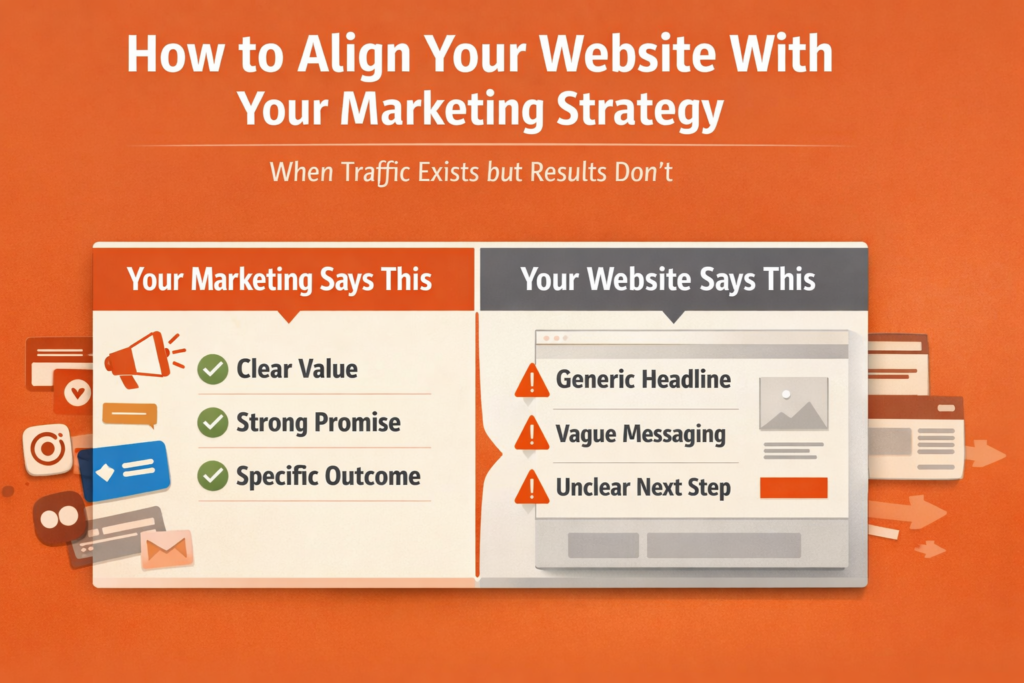
It is a misalignment between what marketing promises and what the website delivers.
This blog explains how to fix that in a practical, step by step way.
First, understand what “alignment” actually means
Website and marketing alignment does not mean
Using the same colors
Repeating the same slogans
Adding more CTAs
Alignment means that every marketing message and every website page work toward the same outcome.
When alignment exists
Visitors immediately understand what you do
They see continuity from ad to page
They know what action to take next
When alignment is missing
Traffic increases but conversions do not
Users feel confused or unsure
Marketing spend feels wasted
Alignment is about clarity, not aesthetics.
Step 1: Start from the marketing promise, not the website
Most websites are built first.
Marketing is layered on later.
This is where the disconnect begins.
Your marketing is already making a promise.
Your website must fulfill that exact promise.
Look at your active marketing channels
Ads
Email campaigns
Social content
SEO blogs
Ask one question
What outcome or transformation are we promising?
If your ads talk about saving time but your website talks about features, there is misalignment.
If your content talks about simplicity but your website feels complex, there is misalignment.
Your website should be the continuation of the marketing conversation, not a reset.
Step 2: Match pages to intent, not traffic sources
One of the biggest mistakes teams make is sending all traffic to the homepage.
In 2026, this rarely works.
Different marketing efforts attract people at different stages.
For example
SEO blogs attract people trying to understand a problem
Ads often attract people closer to a decision
Social content attracts curiosity and early interest
Your website needs pages that match these intents.
This means
Educational content leading to explanation pages
Decision focused traffic landing on conversion pages
Awareness traffic being guided, not pushed
Alignment improves when the page answers the exact question the visitor already has in mind.
Step 3: Make your value proposition instantly clear
In 2026, attention is extremely limited.
Visitors decide within seconds whether to stay or leave.
Your website must answer three questions immediately
What do you do
Who is it for
Why should I care
If marketing brings the right audience but the website fails to communicate this clearly, alignment breaks.
Avoid vague statements.
Avoid industry jargon.
Avoid making users work to understand you.
Clarity is conversion.
Step 4: Align messaging across content, not just headlines
Alignment is not only about top sections or hero banners.
It runs through
Headlines
Subheadings
Body copy
CTAs
If your marketing tone is confident and direct, but your website sounds generic or corporate, trust breaks.
Consistency in voice and message builds familiarity.
Familiarity builds confidence.
Confidence drives action.
Your website should feel like it is spoken by the same person who wrote your ads or posts.
Step 5: Connect content with the buyer journey
Marketing and website alignment improves dramatically when you map content to the buyer journey.
Most websites only speak to decision stage users.
But marketing attracts people at different stages.
A well aligned website includes
Pages that explain problems
Pages that compare solutions
Pages that support decisions
This ensures that users are not forced to jump ahead before they are ready.
Alignment means meeting users where they are, not where you want them to be.
Step 6: Design supports marketing, not the other way around
Design often becomes the silent blocker.
Beautiful websites fail when they prioritize aesthetics over clarity.
In 2026, good design
Guides attention
Highlights key messages
Makes actions obvious
If your marketing CTA is strong but the website hides it, alignment breaks.
If your marketing message is simple but the website layout feels busy, alignment breaks.
Design should support understanding, not distract from it.
Step 7: Align conversion actions with marketing goals
Many websites have too many CTAs.
Talk to sales
Book a demo
Download a guide
Subscribe
Contact us
Marketing usually has one clear goal per campaign.
Your website should reflect that.
If your campaign goal is lead generation, the website should guide users toward that outcome clearly and confidently.
Alignment improves when every page has one primary action, not five competing ones.
Step 8: Use data to validate alignment, not just opinions
Alignment is not guesswork.
Use real signals
High traffic but low conversion pages
High bounce rates from paid campaigns
Drop offs in key flows
These signals usually point to message mismatch, not poor traffic quality.
Instead of asking
Why are users not converting
Ask
What did they expect that they did not find?
That question leads to better fixes.
Step 9: Keep SEO and marketing messaging in sync
SEO content often drifts away from brand messaging.
This creates confusion.
If your SEO blogs educate well but your service pages feel sales heavy or unclear, users hesitate.
SEO should attract the right audience.
Website messaging should reassure them they are in the right place.
When SEO content and core pages speak the same language, trust increases.
Step 10: Treat alignment as an ongoing system
Alignment is not a one time task.
Marketing evolves.
Products evolve.
Customer expectations evolve.
Your website must evolve with them.
This means
Regular content updates
Message reviews
Conversion testing
Page improvements
Teams that treat alignment as a system perform better over time than teams that treat it as a redesign project.
What alignment looks like when it works
When your website and marketing are aligned
Traffic quality improves
Conversion rates stabilize
Sales conversations start warmer
Marketing spend feels justified
Most importantly, growth feels predictable instead of random.
Final summary
• Marketing creates expectations. Your website must fulfill them clearly.
• Alignment starts with intent, not design.
• Pages should match where the user is in their journey.
• Messaging consistency builds trust faster than persuasion.
• Design should guide action, not distract from it.
• Data reveals misalignment more accurately than opinions.
• SEO, content, and conversion pages must speak the same language.
• Alignment is an ongoing system, not a one time fix.