
A Clear, Honest Guide to When It Works, When It Breaks, and How to Use It Correctly
Performance marketing is often pitched as a shortcut to growth.
Run ads. Get traffic. Generate leads. Scale fast.
For many founders, that promise sounds logical. You put money in and expect measurable results out. But in reality, performance marketing rarely works that cleanly, especially for early stage or growing businesses.
In 2026, performance marketing still works very well. But it only works when it is used in the right context and supported by the right foundations. Without that support, it becomes one of the fastest ways to waste money.
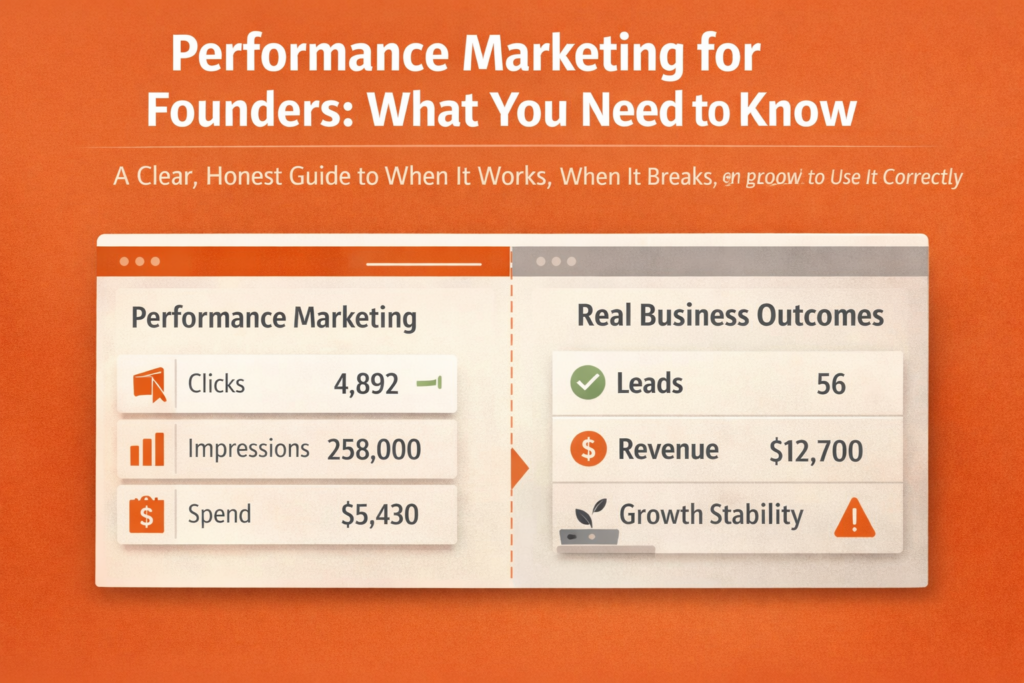
At Grainzap, we regularly work with founders who feel frustrated by ads. They are getting clicks, impressions, and dashboards full of numbers, but very little real business impact.
This blog explains what performance marketing actually is, why founders often struggle with it, and how to approach it in a way that creates predictable growth instead of stress.
What performance marketing really means
Performance marketing is a form of marketing where success is measured through clear and trackable actions. These actions usually include leads, purchases, signups, bookings, or installs.
Unlike brand marketing, which focuses on visibility and recall, performance marketing is judged by outcomes. If people do not take the intended action, the marketing is not performing.
Common performance marketing channels include search ads, social media ads, retargeting campaigns, and marketplace advertising. What connects all of them is accountability. Every campaign is expected to show measurable results.
This clarity is why performance marketing appeals strongly to founders.
Why founders are drawn to performance marketing
Founders are builders and problem solvers. Performance marketing feels logical because it mirrors how businesses think. You invest money, track performance, and expect a return.
It also offers speed. Unlike SEO or branding, ads can bring traffic almost immediately. This makes performance marketing attractive for testing ideas, validating demand, or accelerating early traction.
However, speed without structure creates problems. Many founders start performance marketing before their business is actually ready for it.
The biggest misunderstanding founders have
One of the most common misconceptions is believing that performance marketing creates demand.
It does not.
Performance marketing captures existing demand. It amplifies what is already working. It does not fix unclear positioning, weak messaging, or confusing websites.
If your offer is unclear or your website fails to build trust, performance marketing will not solve that problem. It will simply expose it faster and at a higher cost.
This is why many founders say ads did not work for them. In most cases, the ads did exactly what they were supposed to do. The system behind them was not ready.
When performance marketing works well
Performance marketing works best when a few fundamentals are already in place.
It performs well when your value proposition is clear, your website explains what you do without confusion, and your offer solves a real and specific problem. It also works better when you understand your audience and their buying behavior.
For example, if people already convert through referrals or organic traffic, performance marketing can help scale that success. In this case, ads act as an accelerator.
Performance marketing is most effective when it builds on something that already works.
When performance marketing fails
Performance marketing usually fails because of foundational issues rather than poor ad platforms or targeting.
It often breaks when messaging is unclear and visitors cannot quickly understand what the business offers or why it matters. Weak landing pages that lack credibility or direction also cause users to drop off before taking action.
Poor user experience is another major factor. Slow loading pages, cluttered layouts, or confusing navigation create friction that ads cannot overcome. Many businesses also make the mistake of offering too many conversion actions on one page, which overwhelms users instead of guiding them.
Finally, a missing or weak follow up system causes even interested leads to go cold. When these problems exist, ads bring traffic, but traffic does not turn into results.
Understanding the real cost of performance marketing
Performance marketing costs more than just ad spend.
There are additional investments that founders often underestimate. These include creative testing, landing page optimization, analytics setup, conversion tracking, and time spent learning and improving campaigns.
Founders who only budget for ads often feel performance marketing is expensive and unpredictable. Founders who understand the full system plan better and scale more sustainably.
Performance marketing is not a plug and play solution. It is an operating system.
How performance marketing works in 2026
In 2026, performance marketing is closely tied to user experience and trust.
Ad platforms now reward relevance, engagement, and post click behavior. If users do not engage with your website or take action, costs increase and reach decreases.
This means founders need to think beyond targeting and creatives. They need to focus on clarity, credibility, and simplicity.
Today, performance marketing rewards businesses that make it easy for users to understand, trust, and act.
Performance marketing versus branding and SEO
Performance marketing is not a replacement for branding or SEO.
Each plays a different role in growth. Branding builds trust and recognition. SEO builds long term visibility and authority. Performance marketing captures demand quickly.
Businesses that rely only on performance marketing often feel constant pressure to spend more. Businesses that combine it with branding and SEO build stability.
The strongest growth strategies use all three together.
How founders should start performance marketing
Founders new to performance marketing should start small and intentionally.
Begin by defining one clear goal for a campaign. This could be lead generation or bookings, but not multiple objectives at once. Next, ensure the landing page is built specifically for that goal and removes unnecessary distractions.
Tracking should cover the full journey, not just clicks. Founders should understand what happens after someone lands on the website. Early campaigns should focus on learning rather than immediate profit.
This approach reduces waste and builds confidence.
How to improve performance marketing that is already running
If ads are already live but results are inconsistent, the solution is rarely more spend.
Founders should look at where users drop off, what questions remain unanswered, and what objections are not addressed on the page. Often, improving messaging clarity or simplifying the conversion flow has a bigger impact than changing targeting.
Performance marketing improves when the entire system improves.
Common mistakes founders should avoid
Many founders struggle with performance marketing because they scale too early, change agencies instead of fixing fundamentals, or judge results too quickly. Others expect ads to solve deeper business problems or ignore the website experience entirely.
Avoiding these mistakes saves both money and momentum.
How Grainzap helps founders make performance marketing work
Many founders come to Grainzap after feeling stuck with ads.
They are spending money but lack clarity on what is broken.
We help founders by auditing the entire funnel, aligning messaging with business goals, improving website experience, and building performance systems that are designed to scale. Our focus is not just on running ads, but on making sure performance marketing actually performs.
When the foundation is right, performance marketing becomes predictable instead of stressful.
Final summary
Performance marketing is a results driven growth tool, not a magic solution. It works best when the product, message, and website are already clear. Ads do not create demand; they amplify what already exists. In 2026, clarity, trust, and user experience matter more than clever targeting. Performance marketing works best when combined with branding and SEO, not used in isolation. Grainzap helps founders fix the system behind the ads so growth becomes sustainable.