
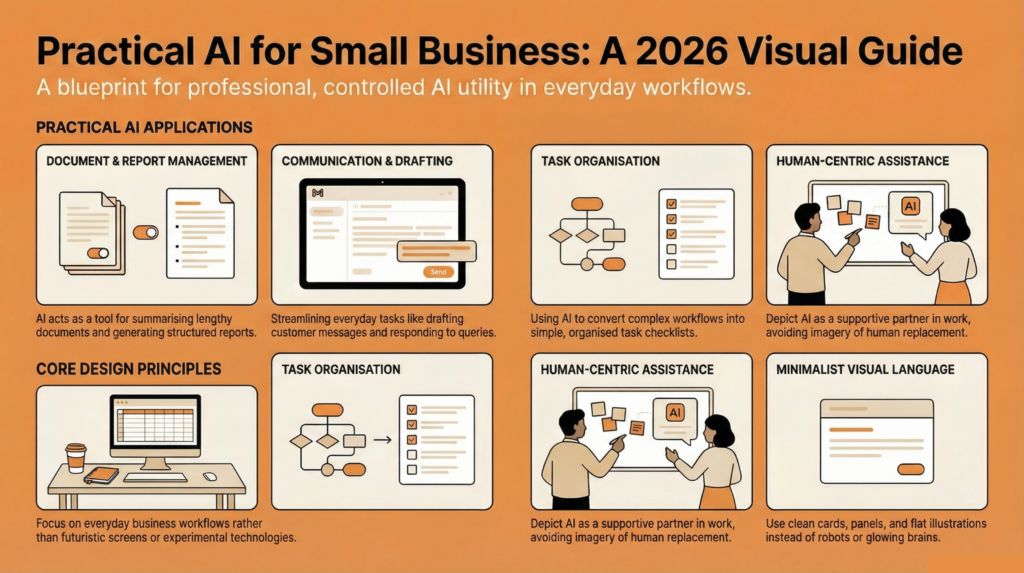
What Works in Real Businesses, What Fails, and How to Use AI Without Losing Control
In 2026, AI adoption among small businesses has moved past experimentation.
Most owners now know that AI can help. The real question is where it genuinely improves efficiency and where it quietly creates new problems.
The businesses seeing real benefits are not using AI everywhere. They are using it with restraint, structure, and accountability.
At Grainzap, we work with small and medium businesses across ecommerce, services, healthcare, and local brands. The pattern is consistent. AI delivers value when it supports clearly defined processes. It fails when it is expected to replace thinking, ownership, or responsibility.
This blog goes deep into how small businesses are actually using AI in 2026, with real workflows, examples, and practical guardrails.
How successful small businesses think about AI
Before tools or tactics, mindset matters.
Businesses that succeed with AI do not start with tools. They start with friction.
They ask questions like
Which tasks repeat daily
Where do teams lose time
What work adds little strategic value
AI is introduced only where
The task is repetitive
The rules are predictable
A human can review the outcome
This mindset prevents tool overload and keeps AI useful instead of overwhelming.
AI in customer support: faster responses without losing trust
What the problem looked like before AI
Small businesses often rely on WhatsApp, Instagram DMs, or email for customer support. Owners or small teams spend hours answering the same questions about pricing, delivery timelines, availability, and policies. Slow replies directly reduce conversions.
How AI is actually used
AI is used as a first response layer, not a full replacement.
A typical workflow looks like this
Customer message arrives → AI identifies intent → AI answers common questions → Complex or emotional cases move to a human
What changed in practice
A mid sized ecommerce brand selling personal care products implemented AI support for FAQs.
Results after three months
Around two thirds of routine queries were handled instantly
Human agents focused on order specific and sensitive issues
Chat to purchase conversion improved due to faster replies
The key factor was training AI on business specific rules, not generic answers.
AI for content creation: removing friction, not replacing voice
The problem before AI
Content creation slowed down because owners lacked time or clarity. Blogs, product descriptions, emails, and social posts remained inconsistent.
How AI is actually used
AI generates structured drafts. Humans refine messaging.
A realistic workflow
Human defines intent → AI drafts content → Human edits for clarity and accuracy → AI refines structure → Final publish
Real impact
A service based business publishing blogs used AI for outlines and first drafts.
Outcome
Publishing frequency doubled
Time per article dropped significantly
Content quality improved because founders spent time refining insight, not fighting blank pages
AI removed resistance, not thinking.
AI in marketing: improving decisions, not replacing strategy
The problem before AI
Marketing decisions were based on assumptions. Founders did not know which messages or offers actually worked.
How AI is actually used
AI is used to analyze patterns and summarize insights.
Example workflow
Campaign data → AI summarizes performance → Human adjusts strategy
Practical result
A local fitness studio used AI to analyze ad creatives and audience engagement.
Results
Clear messaging themes emerged
Low performing variations were eliminated faster
Ad spend became more efficient
AI shortened learning cycles, but strategy decisions stayed human.
AI in sales: prioritizing effort instead of increasing pressure
The problem before AI
Sales teams wasted time on low intent leads. Follow ups were inconsistent. Notes were fragmented.
How AI is actually used
AI supports lead qualification and communication preparation.
Workflow
Lead enters system → AI summarizes context → AI flags priority → Human conducts conversation
Result
A consulting firm improved close rates by focusing on high intent conversations instead of chasing every inquiry.
AI improved focus, not persuasion.
AI in operations: reducing invisible workload
The problem before AI
Operational tasks like reporting, documentation, and coordination consumed time without adding visible value.
How AI is actually used
AI automates summaries and documentation drafts.
Example
A retail business used AI to generate weekly sales summaries and inventory insights.
Outcome
Faster decision making
Less administrative fatigue
Better team alignment
AI removed invisible friction, not accountability.
AI in website optimization: understanding why users leave
The problem before AI
Website analytics existed, but business owners could not interpret them easily.
How AI is actually used
AI translates behavior data into insights.
Example
A service business used AI to identify drop off points and unclear messaging.
After implementing suggested clarity improvements
Bounce rate decreased
Lead submissions increased
AI helped diagnose issues, not redesign blindly.
Where small businesses should NOT use AI
This is where restraint matters most.
AI should not be used to make pricing decisions without human oversight. Pricing involves market perception, positioning, and long term brand impact that AI cannot fully understand.
AI should not handle sensitive customer issues end to end. Complaints, refunds, or emotional situations require empathy and judgment that only humans can provide.
AI should not define long term business strategy. Strategic decisions involve risk, vision, and accountability that cannot be outsourced to a tool.
AI should not replace experienced team members. It can support their work, but removing human expertise weakens decision quality.
AI fails when accountability is removed. Businesses lose control when they stop reviewing, questioning, and owning outcomes.
A realistic AI adoption roadmap for small businesses
A structured approach works best.
First, identify one repetitive bottleneck.
Second, introduce AI as support, not replacement.
Third, review outputs consistently.
Fourth, document workflows clearly.
Fifth, expand only after measurable improvement.
This keeps AI aligned with business goals.
Why many small businesses still struggle with AI
Most struggles come from
Using too many tools
No defined workflows
No clear ownership
Expecting AI to think independently
AI works best when humans remain in control.
How Grainzap helps small businesses use AI deeply and responsibly
Many businesses reach Grainzap after experimenting with AI and feeling overwhelmed.
We help by
Identifying high impact use cases
Designing AI plus human workflows
Selecting tools based on business maturity
Ensuring AI improves outcomes without reducing accountability
Our focus is depth, not novelty.