
Running a restaurant today is not just about good food.
It is about speed, accuracy, and how smoothly the entire floor operates, especially during peak hours. Many restaurant owners experience the same daily challenges. Customers are seated, staff are busy, orders are shouted across the floor, and mistakes happen when the rush begins.
This is where the idea of a digital ordering system often comes up.
Owners hear terms like table ordering, QR ordering, or self ordering systems, but most are unsure what these actually mean, how they work, and whether they are even worth considering.
This blog explains digital ordering systems in simple terms. It covers how they work, what problems they solve, when they make sense, and when they do not. The goal is clarity, not selling technology.
What Is a Digital Ordering System for Restaurants
A digital ordering system is a setup that allows customers to place their food orders digitally instead of relying entirely on staff to take orders manually.
In most cases, customers use their own smartphones to view the menu and place orders. The order is then sent directly to the kitchen or counter screen, where staff can prepare it.
This system does not require customers to download an app. It usually works through a simple web page that opens when a QR code is scanned.
It is important to understand that this is not the same as food delivery platforms. A digital ordering system is designed for dine in restaurants to manage orders more efficiently inside the restaurant.
How a Table Ordering System Actually Works
To understand it clearly, it helps to walk through a real scenario.
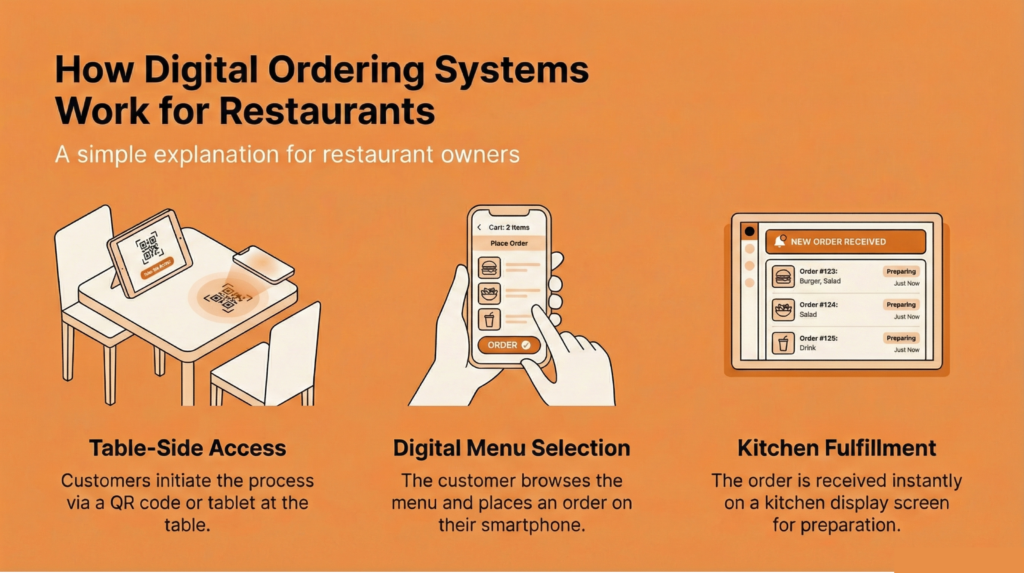
A customer enters the restaurant and is seated at a table. On the table, there is a small QR code stand.
The customer opens the phone camera and scans the QR code. A menu opens automatically in the browser. No app installation is required.
The customer browses the menu, selects items, chooses customizations if available, and places the order.
Once the order is submitted, it appears instantly on a screen in the kitchen or at the billing counter. The kitchen staff starts preparing the food.
When the food is ready, staff serve it to the table, or the system notifies the customer if self pickup is used.
From the customer perspective, the process feels simple and quick. From the restaurant perspective, orders are clear, written, and organized.
What Problems Digital Ordering Solves for Restaurants
Digital ordering systems exist because of real operational pain points.
During peak hours, staff often struggle to keep up with orders. One staff member might be handling multiple tables, taking orders, answering questions, and coordinating with the kitchen.
This leads to common issues such as wrong items being sent, missed customizations, or delays because orders were misunderstood.
For customers, the experience can feel frustrating. They may wait to place an order or struggle to get staff attention when the restaurant is busy.
A digital ordering system removes these bottlenecks. Orders go directly from the customer to the kitchen. There is no need to remember details or run back and forth.
Benefits of a Digital Ordering System from a Restaurant Owner Perspective
From an operational standpoint, digital ordering improves efficiency.
Staff spend less time writing down orders and more time serving food. Kitchen staff receive clear instructions without confusion. Peak hours become more manageable because the system absorbs part of the workload.
From a cost perspective, the pressure to increase floor staff reduces. Fewer order mistakes also mean less food wastage and fewer complaints.
From a customer experience perspective, diners feel in control. They order at their own pace, do not feel rushed, and receive more accurate orders. This leads to higher satisfaction and better reviews.
Digital Ordering System vs Traditional Ordering
Traditional ordering still works in many restaurants, especially smaller setups with low table volume.
However, during rush hours or understaffed shifts, manual ordering struggles to scale. Accuracy depends heavily on staff experience and communication.
Digital ordering brings consistency. Orders are recorded exactly as selected. The system does not get tired or distracted during peak hours.
The key difference is not technology. It is reliability during pressure.
Does Every Restaurant Need a Digital Ordering System
Not every restaurant needs this system.
A small cafe with limited seating and slow pace may manage perfectly well with traditional ordering. Restaurants with a strong personal service model may also prefer manual interaction.
Digital ordering is most useful for restaurants with high dine in volume, frequent rush hours, or limited staff availability.
The decision should be based on workflow, not trends.
App vs Web Based Ordering Systems
Many restaurant owners assume they need a mobile app to offer digital ordering. This is a common misconception.
Most small and medium restaurants do not need a downloadable app. Apps require development, maintenance, and customer adoption.
Web based ordering systems accessed through QR codes work better. They are faster to set up, easier for customers, and more cost effective.
Customers are far more likely to scan a QR code than download an app just to place one order.
Cost and Setup Reality for Small and Medium Restaurants
Cost is often the biggest concern.
Digital ordering systems usually involve a one time setup or a predictable recurring fee, depending on the provider. Hardware requirements are minimal. A tablet or screen in the kitchen is often sufficient.
Staff training is simple because the system mirrors existing workflows. Most teams adapt within a few days.
The real value comes from time saved, reduced errors, and smoother operations, especially during peak hours.
Common Mistakes Restaurant Owners Make
Some owners choose systems that are too complex for their needs. Over engineered solutions often create frustration instead of efficiency.
Others fail to train staff properly or do not explain the system to customers clearly.
Another common mistake is poor menu structuring. If the menu is confusing digitally, customers struggle and staff end up assisting anyway.
Simplicity is the key to success.
How to Decide If a Digital Ordering System Is Right
A few questions help clarify the decision.
Does the restaurant face frequent rush hour chaos
Are order mistakes common
Is staff often stretched thin
Do customers wait too long to place orders
If the answer to several of these is yes, a digital ordering system is worth considering.
How Grainzap Helps Restaurants Implement Digital Ordering Properly
Many restaurant owners approach Grainzap after hearing about digital ordering but feeling unsure where to start.
We focus on understanding real restaurant workflows, not forcing technology. The goal is to simplify operations, not complicate them.
We help restaurants choose the right type of system, design customer friendly ordering flows, and ensure staff adoption. Implementation is done in a way that supports daily operations, especially during peak hours.
Technology only works when it fits naturally into the business.
Final Summary
A digital ordering system allows customers to place orders directly from their table using their phones. Orders flow straight to the kitchen, reducing mistakes and saving staff time. These systems work best during busy hours and understaffed shifts. Not every restaurant needs one, but many benefit from the efficiency and clarity it brings. Web based QR ordering systems are usually more practical than mobile apps. When implemented correctly, digital ordering improves operations, customer satisfaction, and overall control.