
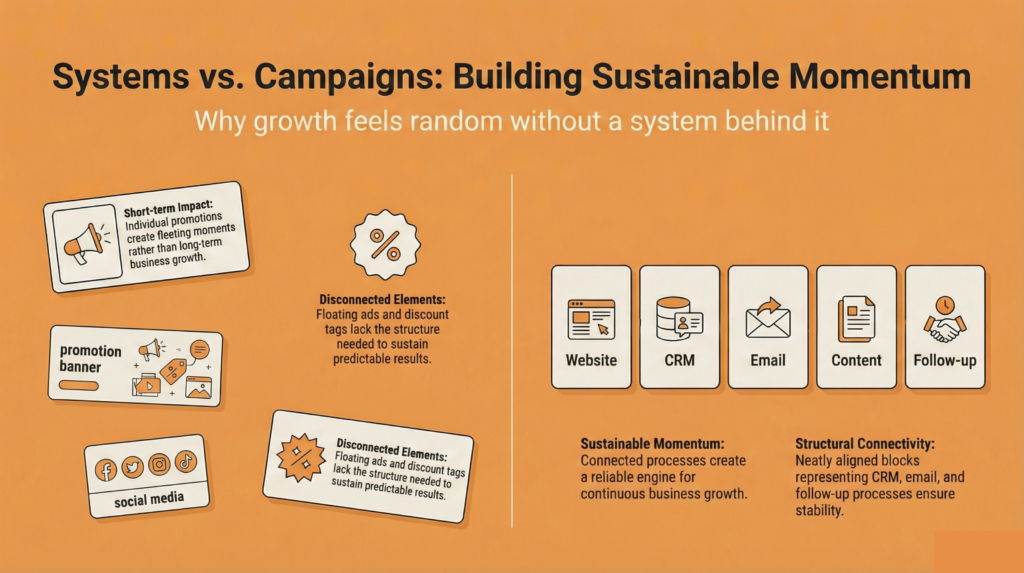
And Why Growth Feels Random Without a System Behind It
Many businesses today are constantly running campaigns.
Instagram ads.
Google ads.
Seasonal discounts.
Influencer collaborations.
Short term promotions.
Something usually works. Traffic comes in. Leads appear. Sales happen.
Then the campaign ends, and everything slows down again.
This is when the same questions start repeating in a business owner’s mind.
Why do leads stop when ads stop
Why does growth feel random
Why do campaigns work once and then fail
If these questions feel familiar, the issue is not effort, creativity, or budget.
The issue is that campaigns alone are not designed to create sustainable growth.
What businesses usually mean when they say “campaigns”
When most small and medium businesses talk about campaigns, they mean short term marketing pushes.
These typically include running paid ads for a few weeks, pushing social media content aggressively, offering discounts for a limited period, or collaborating with influencers to boost reach.
Campaigns are designed to create attention spikes. They are useful for visibility, launches, and short term momentum.
What campaigns are not designed for is long term consistency.
When businesses rely only on campaigns, growth becomes dependent on constant spending and constant effort.
Why campaigns feel effective in the beginning
Campaigns often show results early, which is why businesses trust them.
New audiences see the brand for the first time.
Platforms give temporary reach boosts.
Curiosity leads to clicks and inquiries.
This early traction creates the feeling that growth is happening.
In reality, what is happening is exposure, not growth.
Exposure without a system behind it does not compound. It fades once the push stops.
The real problem is not campaigns, it is the lack of a system
Campaigns are meant to bring people in.
What most businesses do not have is a structure that guides people after the first interaction.
There is often
No clear explanation of value
No nurturing for people who are not ready
No follow up system
No retention strategy
As a result, traffic leaks out quickly. Leads cool down. Money feels wasted.
This is why growth feels unpredictable and stressful.
What a funnel actually means in simple business terms
A funnel is not a tool, a diagram, or software.
A funnel is a systematic journey that guides someone from discovering a business to trusting it, buying from it, and coming back again.
At its core, a funnel answers five critical questions.
How do people find the business
What helps them understand the offer
What builds trust and confidence
What makes them take action
What keeps them connected afterward
If these questions are unanswered, no campaign can create stable growth.
The real difference between campaigns and funnels
Campaigns are short term actions.
Funnels are long term systems.
Campaigns stop when the budget stops.
Funnels continue to work even when ads pause.
Campaigns speak to everyone at once.
Funnels respect that people are at different stages.
Campaigns create noise.
Funnels create direction.
This difference explains why some businesses feel stuck in cycles while others grow steadily.
Why growth feels random without a funnel
Without a funnel, every campaign feels like starting over.
Some people click out of curiosity.
Some are researching.
Some are comparing options.
Some are ready to buy.
Campaigns treat all of them the same way.
This leads to inconsistent conversions, confusing metrics, and emotional decision making. One month feels successful. The next feels disappointing.
Growth feels random because there is no system to stabilize it.
A real world scenario: campaigns without a funnel
Consider a service based business running ads.
Ads drive traffic to a basic website.
The website has minimal explanation.
There is a single contact form.
Some leads submit the form.
Others leave to “think about it”.
There is no follow up.
When the campaign ends, leads stop completely.
The conclusion becomes, ads do not work.
In reality, the business never built a system to convert interest into trust and action.
The same campaign inside a funnel
Now imagine the same business with a simple funnel.
Ads bring traffic.
A focused landing page explains the problem clearly.
Social proof builds confidence.
Email or WhatsApp follow ups continue the conversation.
Retargeting ads remind people over time.
Some people convert immediately.
Others convert days or weeks later.
Sales feel slower initially but far more predictable over time.
The campaign did not change.
The structure did.
Why funnels create consistent growth over time
Funnels work because they align with how people actually make decisions.
Most people do not buy the first time they see something.
They need clarity.
They need reassurance.
They need time.
Funnels provide this space without pressure.
Over time, funnels improve lead quality, reduce acquisition costs, increase repeat purchases, and reduce dependency on constant campaigns.
Growth becomes stable instead of stressful.
Common mistakes businesses make when building funnels
Many businesses fail with funnels because they misunderstand them.
They overcomplicate the process.
They copy templates that do not match their business.
They expect instant results.
They treat funnels as technical projects instead of business systems.
Effective funnels are simple, intentional, and aligned with real workflows.
How small and medium businesses should start thinking in funnels
Funnels do not need to be complex to work.
A simple starting framework is enough.
Understand how people discover the business.
Clarify what builds trust before buying.
Decide the next step after first contact.
Create a basic follow up process.
Even this level of structure creates more stability than running endless campaigns.
Campaigns still matter, but only inside a funnel
Campaigns are not the enemy.
They are incomplete on their own.
Campaigns bring attention.
Funnels decide what happens to that attention.
When both work together, growth stops feeling chaotic and starts feeling intentional.
How Grainzap helps businesses move beyond campaign dependent growth
Many businesses reach Grainzap after feeling exhausted by constant campaigning.
They are creating content.
They are running ads.
They are spending money.
But growth feels fragile.
We help businesses step back and build systems before pushing harder. The focus is on designing simple, practical funnels that match the business reality.
Campaigns then become fuel, not pressure.
Final perspective
Campaigns create moments.
Funnels create momentum.
If leads disappear the moment ads stop, the issue is not marketing effort. It is missing structure.
Real growth happens when businesses stop chasing short term wins and start building systems that compound.
Not louder.
Not faster.
Smarter.